A negative result from the PSA is an official document called a Negative Results Certification (also called Negative Certification or Certificate of No Record) issued by the Philippine Statistics Authority when its database, both electronic archives and paper records, contains no matching entry for the birth, marriage, death, or CENOMAR requested.
Receiving a negative result does not mean the civil registry record does not exist. The PSA issues a negative result whenever its own database lacks the record, regardless of whether the event was properly registered at the Local Civil Registry Office (LCRO). The PSA database and the LCRO local registry are two separate systems. A record confirmed at the LCRO but never transmitted to the PSA produces a negative result every time until the transmittal is completed.
This page explains every cause of a PSA negative result by certificate type, the exact remedies for each cause, the zero-cost re-issuance path available under PSA Memorandum Circular No. 2023-08, and what to do when a negative result is the intended outcome rather than an error.
What Is a PSA Negative Result Certification?
A PSA Negative Results Certification is an official PSA document that proves the agency searched its complete national database and found no matching civil registry record. The document carries the PSA letterhead and official dry seal, states the name and details of the person searched, and confirms no record was located.
The certification is a legal document in its own right. Several government processes require a PSA negative result as a prerequisite, most notably PSA late registration, which requires a Negative Results Certification as the first mandatory document before the LCRO accepts a delayed registration application.
The fee for a Negative Results Certification is P155 at any PSA CRS outlet (the same fee as a standard PSA birth certificate). A confirmed PSA online appointment is required before visiting the outlet. The fee is non-refundable regardless of the result: the P155 covers the cost of the database search itself, not the issuance of a positive certificate.
2 ways a negative result happens in practice:
- The requester receives a Negative Results Certification instead of the certificate they expected (unintended, requires action to resolve)
- The requester deliberately needs a Negative Results Certification as a required document for late registration or a related government process (the negative result is the correct outcome)
The 5 Root Causes of a PSA Negative Result
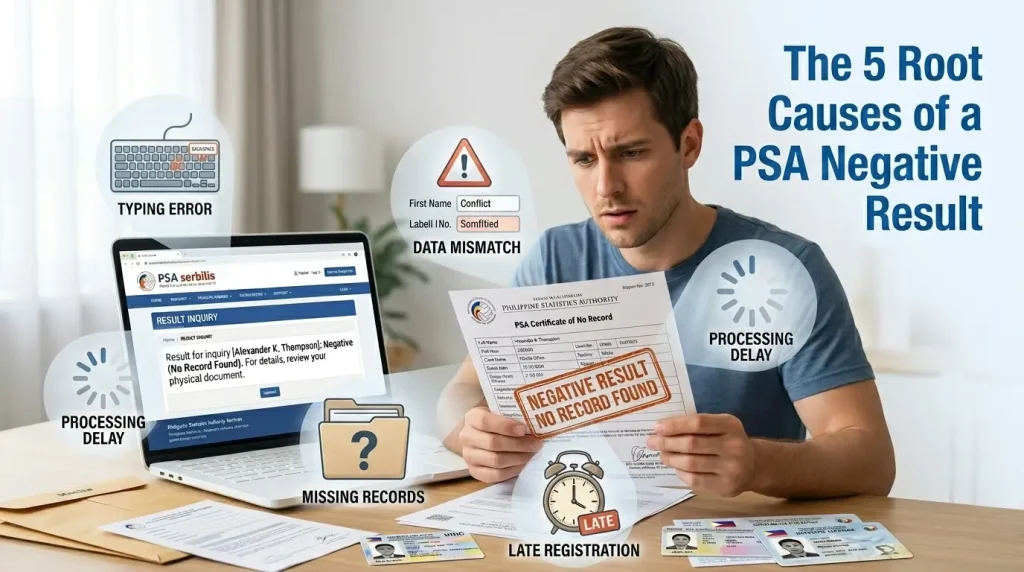
Every PSA negative result for a birth, marriage, or death certificate traces back to one of 5 root causes. Identifying the correct cause determines the correct remedy. Applying the wrong remedy wastes time, fees, and appointment slots.
Cause 1: The LCRO Has the Record But Has Not Yet Transmitted It to the PSA
This is the most common cause of a negative result. Civil registration in the Philippines is a 2-step process: (1) the event is registered at the LCRO, and (2) the LCRO transmits a certified copy to the PSA for national encoding. The PSA only issues certificates from its own database. Records registered at the LCRO but not yet forwarded to the PSA produce a negative result on every request until transmittal is complete.
Remedy: Visit the LCRO where the birth, marriage, or death was registered. Ask whether the record exists in their local registry books. If it does, request the LCRO to endorse a certified copy marked “For OCRG File” directly to the PSA Office of the Civil Registrar General (OCRG) at the 3rd Floor CRS Building, PSA Complex, East Avenue, Quezon City. Keep a copy of the endorsement letter and the forwarder or courier receipt; you will need these to track the transmittal.
After the endorsement is sent, wait 2 to 4 months (Metro Manila records) or up to 6 months (provincial records) before requesting a new PSA copy. Requesting before this window expires will produce another negative result.
Cause 2: The Request Was Filed Too Early After the Civil Event
New civil registry records take time to move through the LCRO-to-PSA pipeline. Even properly registered and transmitted records are not immediately searchable at the PSA. A birth registered today does not produce a PSA-certified copy for months.
Standard encoding timelines:
- Metro Manila records: 2 to 4 months after LCRO registration
- Provincial records: 4 to 6 months after LCRO registration
- Marriages in Metro Manila: 1 to 2 months posting period, then 2 to 4 months encoding
- Marriages outside Metro Manila: 2 to 3 months posting period, then up to 6 months encoding
- Births or deaths reported through a Philippine Embassy abroad (Report of Birth/Death): 6 months after DFA transmittal to PSA
Remedy: Wait the appropriate period and rebook a new PSA appointment online. No action at the LCRO is needed if the event was properly registered within the legal deadline. Checking earlier will produce the same negative result and consume a new appointment fee.
Cause 3: The Birth, Marriage, or Death Was Never Registered
An unregistered civil event produces a negative result at every level, both at the LCRO and at the PSA, because no record was ever created. This situation is different from Cause 1: the LCRO does not have the record at all.
Remedy: File a late registration at the LCRO of the city or municipality where the birth, marriage, or death occurred. For births filed more than 30 days after the event, the Negative Results Certification obtained from the PSA serves as the required proof of non-registration for the LCRO late registration application. The full requirements and 9-step process are covered in the PSA late registration guide.
Cause 4: The Request Details Do Not Match the Registered Record
A name spelling mismatch, incorrect date of birth, or wrong LCRO of registration causes the PSA database search to return no match, even when the record exists. The PSA search algorithm is sensitive to data input. A first name entered as “Ma. Luisa” when the birth certificate was registered as “Maria Louisa” is treated as a non-match. The same applies to transposed birth months, incorrect year of birth, and incorrect province.
4 specific input errors that commonly cause false negative results:
- Nickname used instead of registered legal name (e.g., “Baby” instead of the registered first name)
- Middle name or suffix omitted when the PSA search requires it for disambiguation.
- Birthdate entered with day and month transposed (common for pre-1970 records)
- The wrong LCRO location was entered; the record is filed under the actual place of birth, not the place of residence.
Remedy: Visit the PSA Query Verification Unit (QVU) at the CRS outlet where the negative result was issued and request a re-verification using alternative name spellings or corrected details. The QVU can search under multiple name variants without charging a new request fee. If the record is confirmed in the database under a different spelling, a re-issuance can be requested at no additional cost under PSA Memorandum Circular No. 2023-08 (see Section below).
If the discrepancy is the result of an actual error on the registered birth certificate, not just a search input error- it must be corrected at the LCRO under RA 9048 (clerical errors) or RA 10172 (birth month, day, or gender errors) before the corrected PSA record becomes searchable under the correct name.
Cause 5: The Record Is Too Old to Be in the PSA Digital Database
Records from before 1945 are frequently absent from the PSA digital database because World War II destroyed a significant portion of the civil registry records held by local parishes and early civil registry offices across the Philippines. Registration was optional until 1889, and mandatory civil registration under Act No. 3753 was established in 1930, meaning records from the 1930s and early 1940s are sparse or destroyed.
Remedy for pre-1945 records: After obtaining the PSA Negative Results Certification, proceed to the National Archives of the Philippines for historical record verification. Additionally, church baptismal records, land title documents, and wartime emergency registrations may serve as alternative proofs of birth in lieu of a PSA certificate for estate proceedings and citizenship documentation.
Remedy for recent records that may be too old for digital encoding: LCROs that have not yet fully completed back-digitization of older paper records (1950s to 1970s records from remote municipalities) can be asked to transcribe the registry book entry and endorse the transcription to the PSA-OCRG using LCR Form 1A (birth) or LCR Form 3A (marriage).
Special Case: CENOMAR Negative Result vs Advisory on Marriages
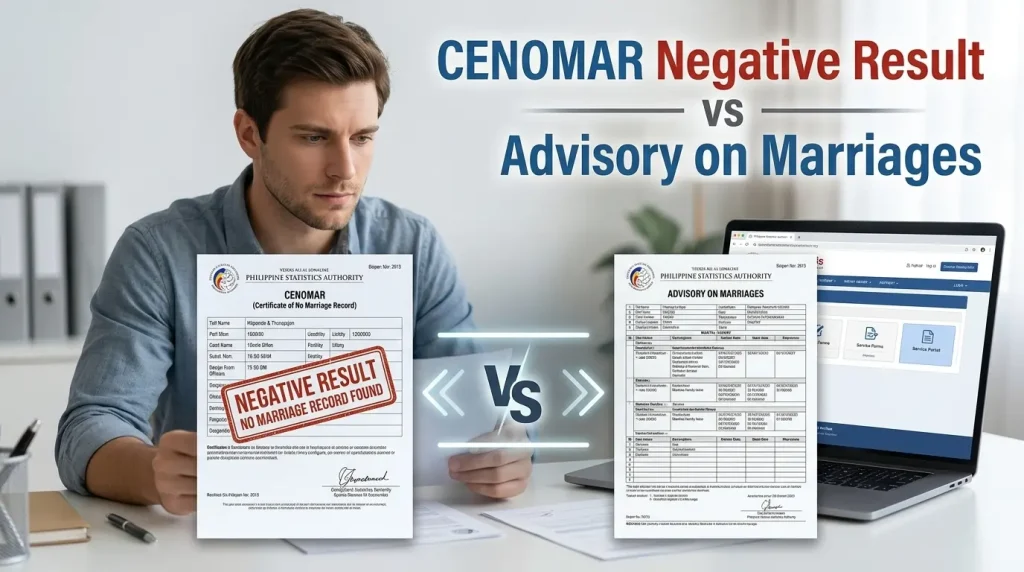
A CENOMAR request produces a different type of unexpected result for people who have a marriage recorded in the PSA database; they receive an Advisory on Marriages instead of a CENOMAR. This is not a negative result in the same sense as a missing record, but it is equally confusing for applicants who expected a CENOMAR.
The PSA system searches its marriage database automatically when a CENOMAR is requested. If any marriage record is found linked to the applicant’s name, the system issues an Advisory on Marriages: a document that lists all marriages found for that individual, rather than a CENOMAR.
3 situations cause an unexpected Advisory on Marriages:
- A previous marriage was registered, and the applicant forgot or was unaware of it.
- A marriage registered under a slightly different name spelling matches the search and produces a hit.
- A foreign marriage was reported to the Philippine Embassy and subsequently transmitted to the PSA.
For applicants who have been annulled, widowed, or who obtained judicial recognition of a foreign divorce, the PSA continues to show an Advisory on Marriages until the annotated marriage certificate reflecting the annulment decree, the death certificate of the spouse, or the court order for judicial recognition is transmitted to the PSA by the LCRO. The annotation must be physically received and encoded by the PSA before the CENOMAR status is restored.
Conversely, a CENOMAR request produces a negative result, meaning no record was found at all, when a previously married applicant’s name does not match any marriage record in the database, often because the marriage was registered under the maiden name and the search was conducted under the married name.
The correct PSA marriage certificate process clarifies which name the LCRO used at registration.
The PSA Zero-Cost Re-Issuance Path
Under PSA Memorandum Circular No. 2023-08, the PSA reissues civil registry documents at no cost when an error on their end caused the wrong result to be issued. 2 specific scenarios qualify for free re-issuance:
- A birth, marriage, or PSA death certificate request resulted in a Negative Certification when a record actually exists in the PSA database (PSA search error)
- A CENOMAR request resulted in an Advisory on Marriages (or vice versa) due to a PSA database or search error.
How to request free re-issuance (for PSA Serbilis or PSAHelpline.ph orders): Send a scanned or photographed copy of the Negative Results Certification printed on security paper and the Official Receipt to the PSA’s verification email. The email subject line must read: “Negative Certification for Validation for Reference No. ” (insert your reference number). After validation and re-verification confirm a PSA-side error, the correct document is reissued at zero cost. The courier retrieves the original Negative Certification upon delivery of the replacement.
If re-verification confirms the negative result is accurate, meaning no PSA-side error occurred, the applicant proceeds with the LCRO endorsement path described above. Free re-issuance does not apply in this case.
For walk-in requests at PSA CRS outlets, raise the issue directly at the Query Verification Unit (QVU) counter before leaving the outlet on the appointment day. The QVU can verify the database status on-site and initiate re-issuance if a search error is confirmed.
Step-by-Step: What to Do After Receiving a PSA Negative Result
The correct action after receiving a PSA negative result depends entirely on which of the 5 root causes applies. Work through these 5 questions in order before taking any action:
Step 1: Rule out a search input error. Compare the details you entered in your PSA request against your LCRO copy (if you have one), your school records, or your baptismal certificate. If you entered a nickname, a wrong birth year, a transposed birth month, or a wrong province, the negative result is likely a false negative caused by input mismatch. Request a QVU re-verification at the PSA outlet using corrected details before visiting any LCRO.
Step 2: Check whether the request was too early. If the civil event occurred within the last 6 months, the encoding pipeline may simply not have completed. Wait the appropriate period and rebook. No LCRO visit is required.
Step 3: Visit the LCRO to confirm whether the record exists locally. If the event occurred more than 6 months ago and the input details are correct, visit the LCRO of the place of the civil event. Ask the civil registrar whether the record appears in their local registry books. This determines whether the cause is Cause 1 (LCRO not yet transmitted) or Cause 3 (never registered).
Step 4: Request an LCRO endorsement if the record exists locally. If the LCRO has the record, request a formal endorsement to the PSA-OCRG. Collect the endorsement letter and courier receipt. Wait 2 to 4 months and request a new PSA copy.
Step 5: File a late registration if no LCRO record exists. If neither the LCRO nor the PSA has the record, late registration at the LCRO is the required path. The Negative Results Certification from the PSA is your first required document for that application.
Frequently Asked Questions
What is a PSA negative result, and does it mean my record is lost?
A PSA negative result means the Philippine Statistics Authority searched its complete national database and found no matching civil registry record for the name and details you provided. It does not mean the record is lost or destroyed. The most common cause is that the Local Civil Registry Office (LCRO) registered the event but has not yet transmitted the record to the PSA. Visit the LCRO where the birth, marriage, or death was registered to confirm whether the record exists locally before concluding that late registration is needed.
How long should I wait before requesting a PSA certificate to avoid a negative result?
For events registered in Metro Manila, wait 2 to 4 months after the LCRO registration date. For events registered in provincial areas, wait 4 to 6 months. For births or deaths reported through a Philippine Embassy abroad, wait 6 months after DFA transmittal to the PSA. Requesting before these periods expire produces a negative result even for properly registered records that are still in the encoding pipeline.
Can I get a refund after receiving a PSA negative result?
The P155 fee covers the cost of the PSA database search and is non-refundable regardless of the result. The only exception is when a PSA-side error caused the wrong result to be issued; in that case, PSA Memorandum Circular No. 2023-08 entitles the applicant to a free re-issuance of the correct document upon confirmation of the error through the PSA Query Verification Unit or PSA Helpline.ph email validation process.
What should I do if my PSA negative result is caused by a name spelling mismatch?
Visit the PSA Query Verification Unit (QVU) at the outlet where the negative result was issued. Request a re-verification under alternative name spellings. The QVU can search multiple name variants without charging a new fee. If the record is found under a different spelling that reflects an actual error on the registered certificate (not just a search input error), the error must be corrected at the LCRO under RA 9048 (clerical errors) or RA 10172 (birth month, day, or gender errors) before a corrected PSA copy becomes available.
Why did my CENOMAR request return an Advisory on Marriages instead of a CENOMAR?
The PSA system automatically searches for marriage records when a CENOMAR is requested. If any marriage linked to your name is found in the database, the system issues an Advisory on Marriages instead of a CENOMAR.
This happens when a previous marriage was registered and is still on record, when an annulment decree or judicial recognition of foreign divorce has not yet been transmitted and encoded by the PSA, or when a name variant in the database matches your search. An Advisory on Marriages is not a negative result in the standard sense; it is the PSA’s affirmative finding that at least one marriage record exists for your name.
Is a PSA negative result the same as a Certificate of No Record?
The terms “Negative Results Certification,” “Negative Certification,” and “Certificate of No Record” refer to the same PSA document. The official document title on the PSA security paper is Negative Results Certification. Certificate of No Record is a commonly used alternative name for the same document. Both terms are used interchangeably by PSA staff, LCROs, and government agencies that require this document as a prerequisite, most notably for PSA late registration applications.