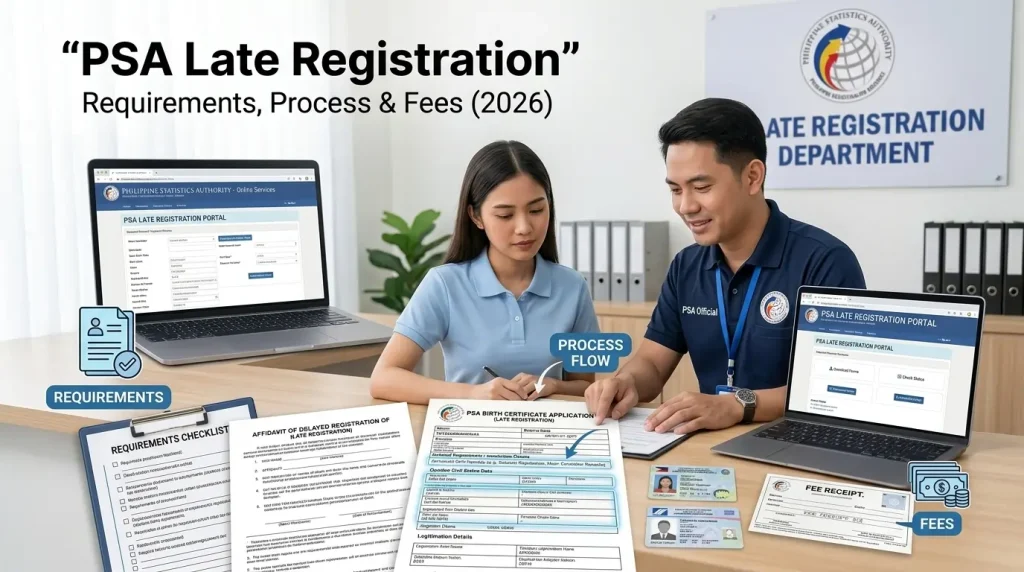
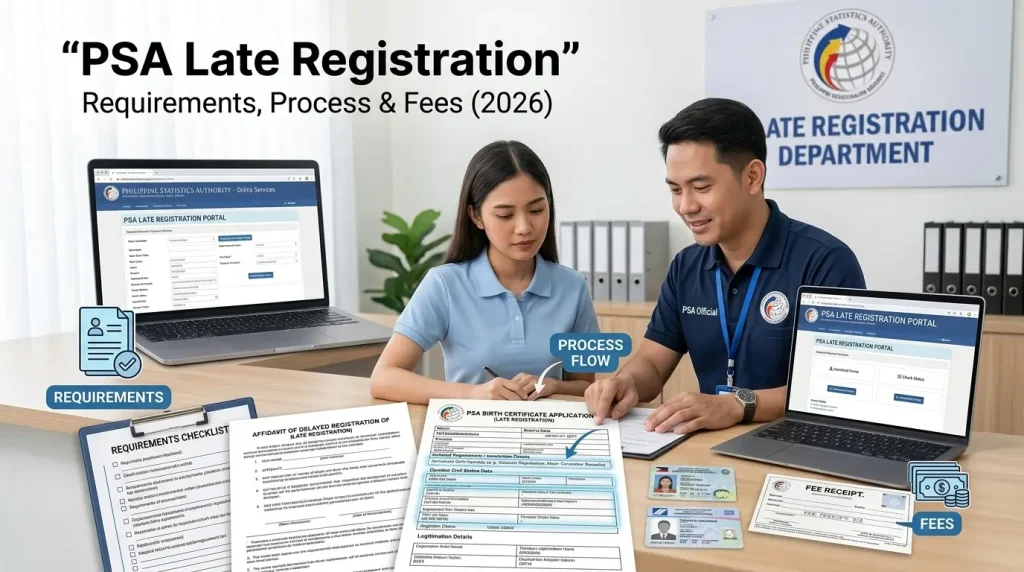
Late registration is the official process for recording a birth, marriage, or death with the Local Civil Registry Office (LCRO) after the legally required filing deadline has passed. Under Act No. 3753 (Civil Registry Law of the Philippines), births must be registered within 30 days from the date of birth. Any registration filed after that 30-day window is classified as a delayed or late registration.
The PSA does not process late registrations directly. The LCRO of the city or municipality where the birth, marriage, or death occurred is the first and mandatory point of entry. Once the LCRO approves and records the registration, it transmits the record to the PSA Main Office for national archiving. The PSA then issues the certified copy on security paper (SECPA) after encoding is complete.
This page covers every requirement for late registration by age group, the 9-step process from LCRO filing to PSA copy issuance, the complete Affidavit of Delayed Registration format, how to check whether you are already late registered, fees, and what to do when you cannot file at the LCRO of your birth municipality.
What Is PSA Late Registration and Why Is It Not Done Online?
PSA late registration is the legal process of recording a birth, marriage, or death for the first time after the mandatory registration period has already expired. The terms “late registration” and “delayed registration” refer to the same process and are used interchangeably by the PSA and local civil registrars.
3 mandatory registration deadlines exist under the Philippine civil registry law:
- Birth: 30 days from the date of birth
- Marriage: 15 days from the date of the marriage ceremony
- Death: 48 hours from the time of death (or within 30 days in remote areas without an accessible LCRO)
Any filing made after these deadlines automatically falls under late registration rules, which require additional affidavits, supporting documents, and a mandatory 10-day public posting period before the LCRO can approve the record.
Late registration cannot be done online. The PSA’s online appointment system at appointment.psa.gov.ph is for requesting certified copies of records that already exist in the PSA database. Late registration creates a new record from scratch, which requires in-person appearance at the LCRO, original document submission, and physical examination of evidence by the civil registrar. No online equivalent exists for this process under the current PSA and Civil Registrar General rules.
Once the LCRO approves and transmits the late registration, the resulting PSA birth certificate can be requested through the standard PSA online appointment process, but only after the record has been encoded into the national PSA database, a process that takes 2 to 4 months from LCRO approval.
How to Know If You Are Late Registered in PSA
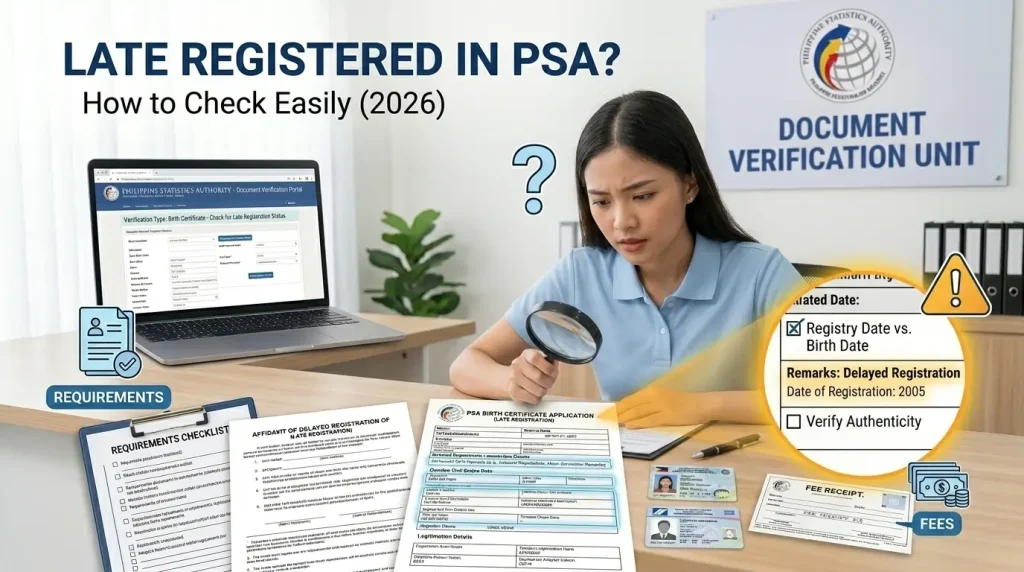
The most reliable way to check whether you are late registered in the PSA database is to request a copy of your PSA birth certificate. The result of that request tells you your exact registration status.
3 possible outcomes exist when you request a PSA birth certificate:
Outcome 1: PSA issues your birth certificate on SECPA. Your birth is registered, and your record exists in the PSA database. Your certificate does not specifically state “late registration” on its face, but if your registration was delayed, the Affidavit of Delayed Registration will appear on the back of your Certificate of Live Birth as an endorsement notation.
If your PSA certificate is issued but shows an NSO logo, you may want to understand the difference between NSO and PSA certificates to know if you need a newer copy for certain transactions.
Outcome 2: PSA issues a Negative Results Certification. No matching birth record was found in the PSA database. This does not automatically mean your birth was never registered. 4 situations can cause a negative result:
(1) your LCRO registered the birth but has not yet transmitted the record to PSA (2) your birth was registered under a slightly different name spelling than the one you searched under (3) the PSA has the record but it has not yet been encoded digitally, or (4) your birth was genuinely never registered and late registration is required.
Outcome 3: PSA issues a Negative Results Certification with an advisory noting “record found at LCRO but not yet endorsed.” Your birth was registered at the local level, but the LCRO has not forwarded the record to the PSA. The solution in this case is to visit the LCRO directly and request an endorsement letter, not to file a late registration.
💡 Pro Tip: Before concluding that late registration is needed, visit your birth LCRO in person and ask whether your birth certificate exists in their local registry books. The LCRO may have your record on file and simply needs to transmit it to the PSA. Filing a duplicate late registration when a record already exists creates a conflict of records that requires a separate correction process to resolve.
If the LCRO confirms no record exists and the PSA has issued a Negative Results Certification, late registration is the correct path forward. The Negative Results Certification from the PSA serves as the first required document in the late registration application. More on what negative results mean is covered in the negative result PSA guide.
PSA Late Registration Requirements: By Age Group
The documents required for late registration differ depending on the age of the person being registered. The Civil Registrar General divides applicants into 3 age categories: children below 7 years old, individuals 7 to 17 years old, and adults 18 years old and above. Each category carries a different document burden based on the evidence available and the legal capacity of the registrant.
Documents Required for All Applicants (Any Age)
Every late registration application requires these 5 core documents regardless of age:
- 4 copies of the Certificate of Live Birth (COLB): PSA Form 102, fully accomplished and signed by the parent, guardian, or the registrant (if 18 or above)
- Affidavit of Delayed Registration, executed by the father, mother, guardian, or the registrant (if of age), notarised, and containing the reason the birth was not registered within 30 days.
- PSA Negative Results Certification confirming no matching birth record exists in the national database
- Affidavit of 2 Disinterested Persons, preferably older neighbours, relatives (not immediate family), community members, or the birth attendant, each with personal knowledge of the birth facts
- Valid government-issued ID of the informant (the person filing the registration)
Additional Documents: Children Below 7 Years Old
For infants and young children, the LCRO leans on medical and community records as primary corroborating evidence. Provide at least 2 of the following:
- Hospital or clinic birth record (if the birth was attended by a medical professional)
- Barangay certification of birth or residency
- Baptismal certificate (if applicable)
- Immunisation or vaccination record (infant immunisation card)
- Midwife or hilot affidavit stating facts of birth.
For unmarried parents where the father acknowledges paternity and the child will use the father’s surname, 2 additional documents are required:
- Affidavit of Admission of Paternity (AAP), executed by the father
- Affidavit to Use the Surname of the Father (AUSF), executed by the mother (for children below 7), in compliance with RA 9255
Additional Documents: Children and Teenagers Aged 7 to 17
The LCRO expects a combination of school and civil records for this age group. Provide at least 2 of the following supporting documents:
- School records: Form 137, report card, or enrollment certification showing name and date of birth
- Baptismal certificate
- Medical or immunisation records
- Barangay certification
- Voter’s registration record (for those 15 and above)
- PSA marriage certificate of parents (if parents were married at the time of birth)
For children 7 to 17 who will use the father’s surname under RA 9255, the AUSF requires both the child’s written consent and the mother’s sworn attestation.
Additional Documents: Adults 18 Years Old and Above
Adults filing their own late registration face the strictest document requirements because the LCRO expects a verifiable identity trail spanning years. Provide at least 2 of the following, with more being stronger:
- Government-issued IDs: PhilID (National ID), driver’s license, UMID, PhilHealth ID, voter’s ID, or passport
- School records: transcript of records, Form 137, diploma, or graduation certificate
- Employment records: SSS E-1 form, SSS or PhilHealth printout, employment certificate
- Voter’s registration record or COMELEC certification
- Marriage certificate (if already married) from the LCRO or PSA
- Baptismal certificate
- Military service record (if applicable)
- Barangay certification covering long-term residency
Adults are the informants of their own registration; the Affidavit of Delayed Registration is executed by the registrant (not a parent) and must explain precisely why the birth was not registered within the legal period.
⚠️ Important: The LCRO has full authority to require additional documents beyond this standard list if the evidence presented is deemed insufficient or inconsistent. LCROs in different cities and municipalities apply these rules with slight local variations. Always call or visit your LCRO before assembling your documents to confirm their specific requirements.
The PSA Affidavit of Late Registration: What It Must Contain
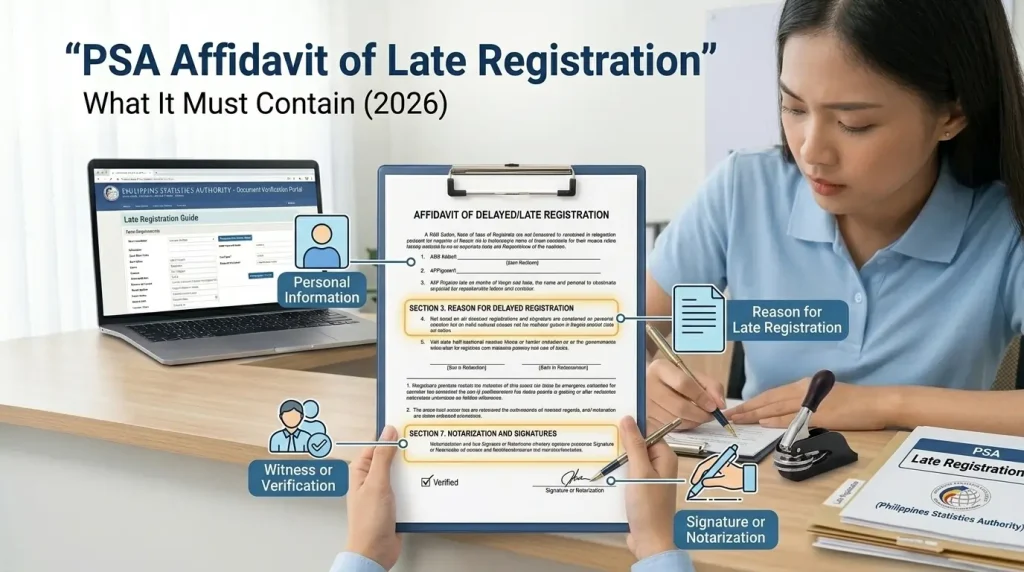
The Affidavit of Delayed Registration (also called the Affidavit of Late Registration) is the sworn statement that explains why the birth was not registered within 30 days of birth. Without this affidavit, the LCRO cannot legally accept the late registration application. The affidavit is printed on the back of PSA Form 102 (Certificate of Live Birth) and must be notarised before submission.
The affidavit must contain 7 specific elements:
- Full name of the registrant (the person whose birth is being registered)
- Date of birth, exact time (if known), and place of birth (barangay, city/municipality, province)
- Full names of both parents and their civil status at the time of birth
- Name of the birth attendant (doctor, midwife, hilot, or midwife’s barangay health centre, if known)
- Specific reason for the delay, the single most scrutinized element; vague reasons such as “we forgot” are not accepted; acceptable reasons include: (a) parents were unaware of the registration requirement, (b) the birth attendant failed to file, (c) the family resided in a remote area without accessible LCRO, (d) records were destroyed in a calamity, or (e) the family was displaced due to armed conflict or natural disaster
- Statement that the facts in the affidavit are true and accurate to the best of the affiant’s knowledge
- Wet (physical) signature of the affiant over their printed name, with their ID details noted
For adults registering their own birth, the affidavit is self-executed. For minors, the father or mother executes the affidavit. If both parents are deceased, the legal guardian executes it and attaches proof of guardianship.
A notary public must administer the oath before the affidavit is signed. The notarization fee is separate from the LCRO registration fee. Bring a valid government-issued ID to the notary appointment.
How to Process Late Registration in PSA: 9-Step Guide
The complete late registration process involves 9 steps, split between the LCRO and the PSA. The LCRO handles the first 7 steps. The PSA handles the final 2 after the LCRO transmits the approved record.
Step 1: Obtain a PSA Negative Results Certification. Visit any PSA CRS outlet with a confirmed PSA online appointment or request the certification online through the PSA Serbilis platform. This document serves as official proof that no existing record was found in the national database. Fee: P155 at the CRS outlet.
Step 2: Visit the LCRO of the place of birth. The late registration must be filed at the LCRO of the city or municipality where the birth occurred. If the birth municipality is inaccessible or you reside far away, an Out-of-Town Registration (OTR) is available: file at your current LCRO, and they forward the complete packet to the LCRO of the birthplace. Expect longer processing timelines with OTR due to inter-office transmittal.
Step 3: Obtain PSA Form 102 (Certificate of Live Birth). The form is available at the LCRO counter. Request 4 copies. The form includes the Affidavit of Delayed Registration on its back page. Fill out all 4 copies completely and accurately, using the exact name, date, and place details consistent with all supporting documents.
Step 4: Execute and notarise the Affidavit of Delayed Registration. Have the affidavit (on the back of Form 102) notarised by a notary public before submitting to the LCRO. Bring the original Form 102, the supporting documents, and a valid ID to the notary. Typical notarization fee: P200 to P500, depending on the notary and the municipality.
Step 5: Assemble all supporting documents. Compile the complete set of documents per the age group requirements listed above. Prepare original documents plus 1 photocopy of each. LCROs retain the photocopies and return the originals after verification.
Step 6: Submit all documents to the LCRO. Present the complete document set at the LCRO counter. The civil registrar examines each document for completeness, consistency, and authenticity. Inconsistencies between documents (such as a name spelled differently in the baptismal certificate vs. the school record) will be flagged and may require correction before acceptance.
Step 7: Wait for the 10-day public posting period. After the LCRO accepts the application, Philippine law requires the civil registrar to post a notice of the pending registration on the LCRO bulletin board for 10 consecutive days. This public notice allows community members to contest the registration if they believe the information is false or fraudulent. If no opposition is filed within 10 days, the civil registrar approves the registration, signs and stamps the COLB, and enters the record in the civil registry books.
Step 8: Wait for PSA encoding — 2 to 4 months. After LCRO approval, the civil registrar transmits the birth record to the PSA Main Office for digital archiving. Encoding into the national PSA database typically takes 2 to 4 months from the date of LCRO transmittal. There is no online tracker for this transmission phase; the only way to confirm the record has been encoded is to request a PSA birth certificate and check whether a certified copy is issued.
Step 9: Request your PSA birth certificate. Once the record appears in the PSA database, request a certified copy on PSA security paper through the standard process. Book a PSA online appointment at appointment.psa.gov.ph, bring a valid ID and the LCRO copy of your birth certificate to the outlet, and pay the certificate fee. For those who booked an online PSA appointment for passport purposes, note that the DFA requires the PSA copy; the LCRO copy is not accepted.
PSA Late Registration Fees and Costs
Late registration fees are set by the local government unit (LGU) of the LCRO where the registration is filed, not by the PSA. This means fees vary by municipality and can change through local ordinances. The PSA charges a separate, fixed fee only when you request the certified copy after encoding.
The typical cost breakdown for a complete late registration in 2026:
| Cost Item | Typical Amount | Who Charges |
| LCRO late registration filing fee | P200 to P500 | LCRO / LGU |
| Notarization of Affidavit of Delayed Registration | P200 to P500 | Notary Public |
| Affidavit of 2 Disinterested Persons (notarization) | P200 to P500 | Notary Public |
| PSA Negative Results Certification (required first) | P155 | PSA |
| PSA birth certificate (after encoding) | P155 per copy | PSA |
| Documentary Stamp Tax | P30 | Bureau of Internal Revenue (via LCRO) |
Total typical cost: P985 to P1,840 for a standard adult late registration, depending on the municipality, the number of affidavits requiring notarization, and the number of PSA copies requested.
Some LGUs waive the LCRO filing fee during Civil Registration Month (February) or through Mobile Registration programs organised by the PSA and local governments in underserved areas. Watch for announcements on your LGU’s official social media pages or the PSA official website at psa.gov.ph.
💡 Pro Tip: Request at least 3 copies of your PSA birth certificate in a single appointment once the record appears in the PSA database. Each copy costs only P155 at the CRS outlet. Requesting copies in separate appointments later costs the same per copy but requires rebooking and returning to the outlet.
Special Cases: Late Registration for OFWs, Births Abroad, and Posthumous Registration
OFW and Births in the Philippines While Abroad
Filipino citizens born in the Philippines whose birth was never registered follow the same LCRO process described above. Physical filing at the LCRO of the birth municipality is required. An OFW abroad cannot file late registration remotely for a Philippine birth, the filing must be done in person or through an authorised representative holding a notarised Special Power of Attorney (SPA).
The PSA authorisation letter format is not sufficient for late registration; an SPA is required because the transaction creates a new legal record rather than merely collecting an existing one.
Filipinos Born Abroad
Births of Filipino citizens that occurred outside the Philippines and were never reported to a Philippine Embassy or Consulate follow a different pathway. A Delayed Report of Birth is filed at the Philippine Embassy or Consulate with jurisdiction over the place of birth, not at an LCRO. The DFA then transmits the approved record to the PSA. A PSA certified copy is requestable 6 months after the DFA transmittal.
Posthumous Late Registration
Late registration of a deceased person is permitted for purposes of estate settlement, pension claims, insurance benefits, and inheritance proceedings. The late registrant’s death certificate must be included in the document package. Affidavits of disinterested persons who personally knew the deceased and can attest to their birth facts carry particular weight in posthumous cases where the registrant cannot self-execute any documents.
Frequently Asked Questions
What is PSA late registration, and can it be done online?
PSA late registration is the process of recording a birth, marriage, or death with the LCRO for the first time after the mandatory filing deadline has passed. Births must be registered within 30 days of birth; any filing after that period is a late registration. The process cannot be done online.
Late registration requires in-person appearance at the LCRO, original document submission, and a 10-day public posting period. The PSA’s online appointment system is only for requesting copies of records that already exist; it does not create new records.
How do I know if I am late in the PSA?
Request a PSA birth certificate through the standard process. If the PSA issues the certificate on security paper, your record exists in the national database. If the PSA issues a Negative Results Certification, your birth may not be in the PSA database, but confirm with your birth LCRO first before assuming late registration is required; your record may be registered locally but not yet transmitted to the PSA.
What documents are required for PSA late registration?
All applicants need 4 copies of PSA Form 102 (Certificate of Live Birth), a notarised Affidavit of Delayed Registration, a PSA Negative Results Certification, and 2 affidavits from disinterested persons. Additional documents depend on age: children below 7 need medical, baptismal, or barangay records; teens 7 to 17 add school records; adults 18 and above need government IDs, SSS or PhilHealth records, employment papers, and other identity-trail documents.
What is the PSA Affidavit of Late Registration, and where do I get the form?
The Affidavit of Delayed Registration (also called the Affidavit of Late Registration) is a sworn statement explaining why the birth was not filed within 30 days. The affidavit text is printed on the back of PSA Form 102, which is available at any LCRO counter. The completed affidavit must be notarised before submission. The form is also downloadable from the PSA official website at psa.gov.ph.
How much does PSA late registration cost in 2026?
The total cost for a standard late registration ranges from P985 to P1,840, depending on the LGU. The main costs are: LCRO filing fee (P200 to P500, set by the LGU), notarization of the Affidavit of Delayed Registration and the 2 disinterested persons’ affidavits (P200 to P500 each), the PSA Negative Results Certification (P155), the Documentary Stamp Tax (P30), and the PSA birth certificate after encoding (P155 per copy). Some LGUs waive the filing fee during Civil Registration Month in February.
How long does it take for a late-registered birth to appear in the PSA database?
After the LCRO approves the registration and the 10-day public posting period ends, the LCRO transmits the record to the PSA Main Office. Encoding into the national PSA database typically takes 2 to 4 months from the date of LCRO transmittal. No online tracker exists for this phase. Confirm whether the record has been encoded by attempting to request a PSA birth certificate approximately 4 months after LCRO approval.
Where do I file late registration if my birth municipality LCRO is inaccessible?
An Out-of-Town Registration (OTR) allows you to file at the LCRO of your current city or municipality. That LCRO packages your complete document set and forwards it to the LCRO of your birthplace for actual registration. OTR applies the same 10-day posting requirement but adds extra processing time due to inter-office transmittal between two LCROs. Confirm OTR availability at your current LCRO before relying on this option.