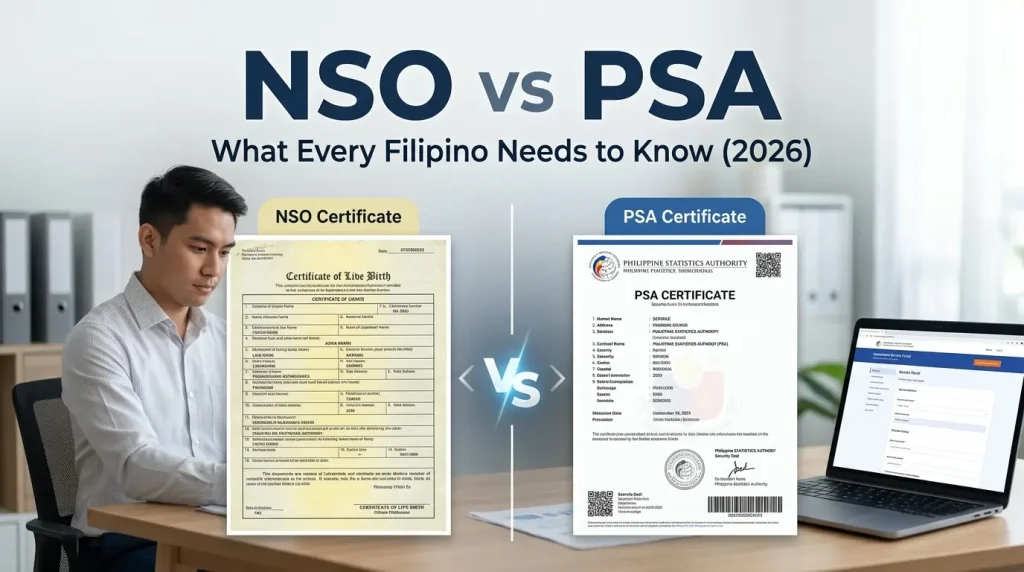
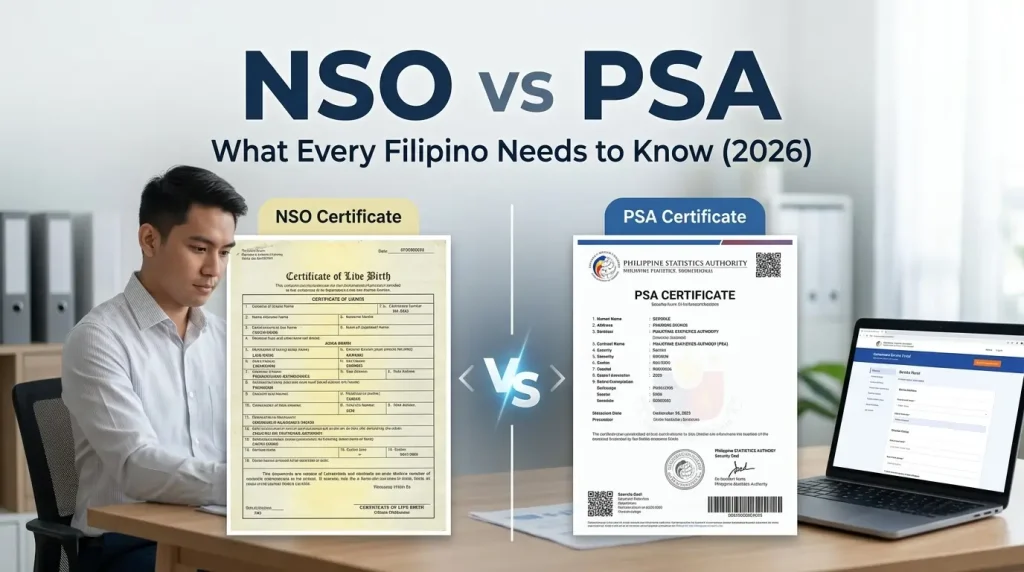
The NSO (National Statistics Office) and PSA (Philippine Statistics Authority) are not two separate agencies: the PSA is the NSO’s direct legal successor, created when the Philippine government merged four statistical agencies into one under Republic Act No. 10625 on September 12, 2013. From that date forward, all civil registry functions that the NSO performed: issuing birth certificates, marriage certificates, death certificates, and CENOMAR, were transferred entirely to the PSA.
Despite this merger being over a decade old, millions of Filipinos still hold certificates bearing the NSO logo and ask the same two questions: Is my NSO document still valid, and do I need to replace it? The answer depends not on the law, which has never invalidated NSO certificates, but on the specific agency or institution requiring the document and the purpose it is being used for.
This page explains the complete history of the NSO-to-PSA transition, every actual difference between an NSO and PSA certificate, when an NSO copy is still accepted, and the 4 specific situations where a PSA-issued copy is required regardless of what you already have.
What Is the NSO, and When Did It Become the PSA?
The National Statistics Office (NSO) was the Philippine government agency responsible for civil registration and national statistics from its establishment in 1940 until its merger into the PSA in 2013. Every Filipino born before mid-2013 who requested a certified birth, marriage, or death certificate received a document printed on yellow security paper bearing the NSO logo.
Republic Act No. 10625, known as the Philippine Statistical Act of 2013, directed the consolidation of 4 separate government statistical agencies into a single authority:
- National Statistics Office (NSO) civil registration and vital statistics
- National Statistical Coordination Board (NSCB) statistical policy and coordination
- Bureau of Labour and Employment Statistics (BLES) labour and employment data
- Bureau of Agricultural Statistics (BAS) agricultural data
President Benigno Aquino III signed RA 10625 on September 12, 2013. The Implementing Rules and Regulations took effect on December 29, 2013, marking the formal operational start of the PSA as the unified agency.
The result: the PSA absorbed all of the NSO’s civil registration functions, including the national database of birth, marriage, death, and CENOMAR records accumulated over decades. No records were deleted. No registrations were voided. The same civil registry database that the NSO maintained became the PSA database. Every certified copy issued after December 2013 carries the PSA logo instead of the NSO logo, but prints from the same underlying registry.
What Is the Actual Difference Between an NSO and a PSA Certificate?
The content of an NSO birth certificate and a PSA birth certificate is identical; both are certified copies of the same civil registry record, printed from the same national database. The differences are entirely physical and administrative, not legal.
4 observable differences exist between an NSO and a PSA certificate:
1. Agency logo and name. The upper-left corner of every NSO certificate carries the NSO seal. PSA certificates carry the PSA seal. This is the difference most Filipinos notice first. The PSA Advisory No. 16-2017 (reiterated in Public Advisory 2023-16) explicitly states that NSO-issued civil registry documents remain authentic and valid; the logo change does not affect legal standing.
2. Security paper (SECPA) design. The PSA updated the physical security paper design after the merger to incorporate new anti-fraud features. PSA certificates printed from 2016 onward include upgraded watermarks, colored security fibres, and guilloche printing patterns not present on older NSO security paper. None of the older SECPA versions is legally invalidated by subsequent updates: the PSA itself confirmed this in its June 30, 2016, statement on birth certificate permanence.
3. QR code. PSA certificates issued through online platforms (PSA Serbilis, PSAHelpline.ph) and e-certificate channels include a machine-readable QR code that links directly to the PSA digital verification system. NSO certificates have no QR code. This matters for DFA apostille verification and institutional verification by banks and embassies. The QR code allows instant digital authentication that NSO copies cannot provide.
4. E-certificate format. The PSA launched its e-certificate platform on February 25, 2026, offering cryptographically secured digital certificates for birth, marriage, and death records at P290 per copy. No NSO equivalent exists. E-certificates are valid for 60 days from issuance and are delivered by email. This format has no historical NSO counterpart.
What has not changed: the name on the certificate, the date of birth, the parents’ names, the place of birth, the registry number, the LCRO endorsement, and the legal authority of the document as prima facie evidence under Rule 132, Sections 30 to 44 of the Rules of Court.
Is an NSO Certificate Still Valid in 2026?
NSO civil registry certificates do not expire and have not been legally invalidated by the transition to the PSA. RA 10625, its Implementing Rules and Regulations, and all subsequent PSA advisories confirm that NSO-issued copies retain full legal validity as certified evidence of civil registry records.
The PSA’s own Advisory No. 16-2017 states that NSO-issued documents are authentic and valid. The DFA’s apostille requirements page at apostille.gov.ph lists both PSA and NSO documents as acceptable for authentication, provided the entries are clear and legible.
For the overwhelming majority of domestic Philippine transactions: school enrollment, employment requirements, SSS and PhilHealth benefit applications, bank account openings, court proceedings, and local government transactions, an NSO certificate presented in good condition is accepted without question.
The practical rule: if the requirement says “PSA birth certificate,” bring a PSA copy. If the form says “civil registry document” or “birth certificate” without specifying the issuing authority, an NSO copy is generally accepted.
4 Situations Where a PSA Copy Is Required Even If You Have an NSO Certificate
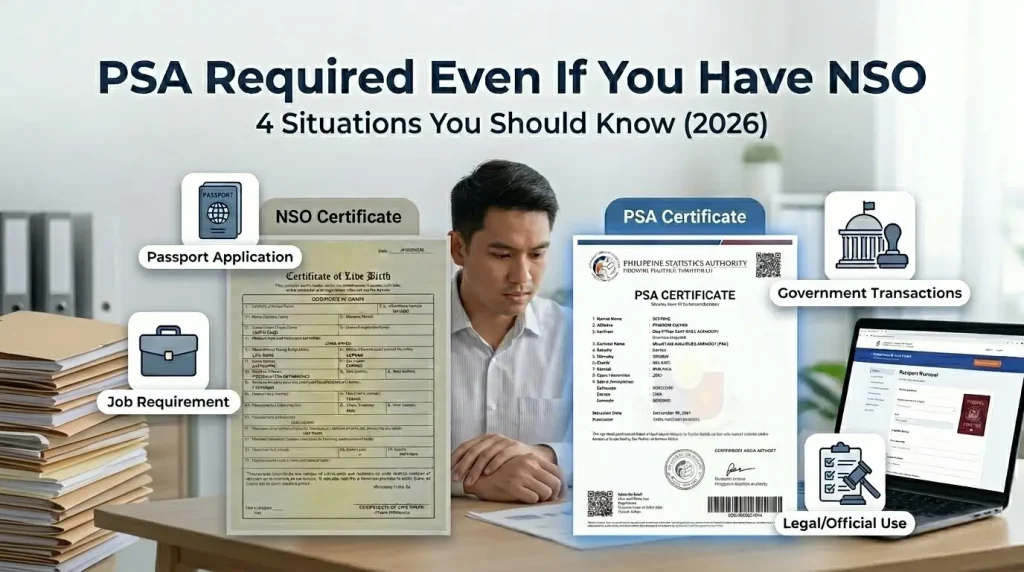
4 specific situations exist where a PSA-issued copy is required, regardless of what your NSO certificate shows. In these cases, the NSO copy is either legally superseded, technically insufficient, or administratively rejected.
Situation 1: DFA apostille for international use. The Philippines joined the Hague Apostille Convention on May 14, 2019. The DFA’s apostille requirements specify PSA-issued or NSO-issued documents as acceptable; however, the DFA’s integrated digital apostille system, launched after the Hague Convention accession, operates exclusively with PSA QR codes for digital verification.
For e-apostille requests through PSAHelpline.ph, only PSA-issued documents transmit correctly through the digital pipeline to the DFA-OCA. An NSO copy submitted for apostille is handled under the paper process but must meet clarity standards; faded or degraded NSO copies are rejected. For any international document submission, request a fresh PSA copy to eliminate the risk.
Situation 2: The civil registry record was corrected or annotated after the NSO copy was printed. Under RA 9048 (clerical error correction) and RA 10172 (date, month, and gender corrections), approved corrections are endorsed by the LCRO back to the PSA. The PSA then updates the national database and issues an annotated copy reflecting the change.
Once the corrected PSA record exists, the old NSO copy showing the pre-correction information becomes legally superseded for evidentiary purposes, and courts and agencies rely on the most current certified copy. Presenting an unannotated NSO copy after a correction has been approved creates a discrepancy and may require explanation or a new PSA copy to resolve.
Situation 3: The record was amended due to adoption, legitimation, or court-ordered name change. Court proceedings under RA 9858 (legitimation of children born to parents below marrying age), RA 11222 (simulated birth rectification), Rule 103 (change of name), and adoption decrees all result in an amended civil registry entry.
The PSA issues an updated SECPA copy with the amendments noted as annotations. The original NSO copy does not reflect any of these changes and cannot be used where the amended status is material, for example, in an adoption proceeding, the court and the DFA require the annotated PSA copy showing the adoption.
Situation 4: The NSO copy is faded, damaged, or illegible. NSO security paper printed before 2005 is prone to ink fading, particularly in humid storage conditions. The PSA acceptance standard for any civil registry document at a CRS outlet, at the DFA, and at most government agencies requires that all entries be clearly legible.
A damaged or faded NSO copy is rejected on sight, regardless of its legal validity. The standard solution is to request a new PSA-certified copy from the same underlying registry record; the data does not change, only the physical medium.
If your NSO certificate is not found in the PSA database due to encoding issues or a missing transmittal, you may receive a negative result from the PSA when you request a copy.
NSO vs PSA: Side-by-Side Comparison
| Feature | NSO Certificate | PSA Certificate |
| Issuing agency | National Statistics Office (defunct since 2013) | Philippine Statistics Authority (current) |
| Years issued | 1940 to late 2013 | Late 2013 to present |
| Agency logo | NSO seal | PSA seal |
| Security paper version | Original SECPA (no QR code) | Updated SECPA with QR code (from ~2016) |
| E-certificate version | Not available | Available from February 2026 at P290/copy |
| Legal validity | Valid, does not expire | Valid, does not expire |
| DFA apostille (digital pipeline) | Paper process only; QR verification unavailable | Full digital pipeline available |
| Reflects post-2013 corrections | No, only PSA can issue annotated copies | Yes, all annotations reflected |
| Accepted for domestic transactions | Yes, generally | Yes, universally |
What Does a PSA Certificate Say That an NSO Certificate Does Not?
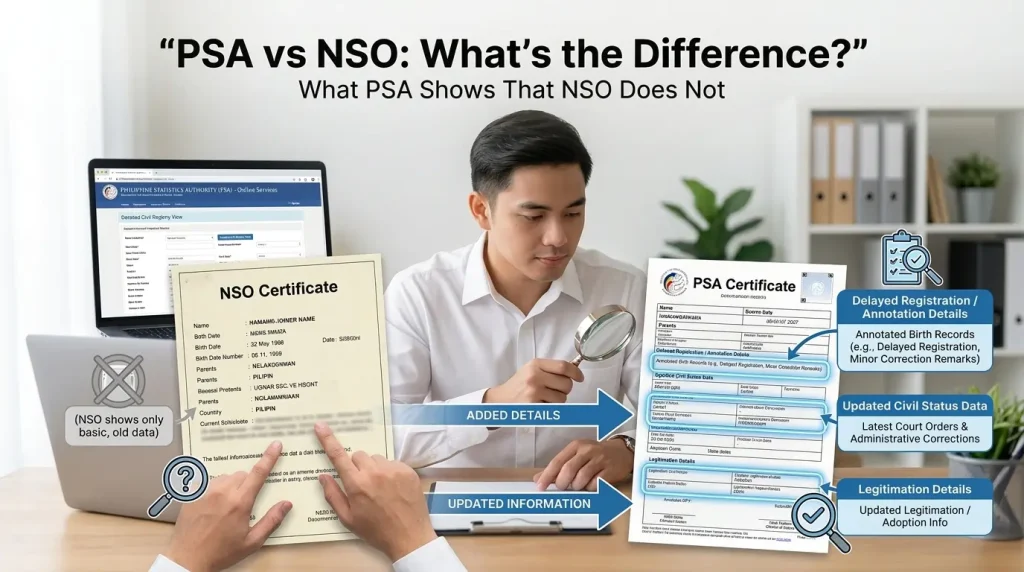
The only new element that appears on PSA certificates but not on NSO certificates is the PSA logo, updated SECPA security features, and the QR code (on copies issued through online platforms from approximately 2016 onward). The data fields: name, date, place, parents, registry number, and LCRO endorsement, remain structurally identical between NSO and PSA copies of the same record.
One practical note for online PSA appointments for passport applications: the DFA requires the birth certificate to be consistent with all other submitted IDs. If a name discrepancy exists between an old NSO copy and a current government ID (even a minor spelling difference), the DFA will flag the inconsistency. Requesting a fresh PSA copy eliminates the risk of a mismatch between an old NSO printout and current database entries, particularly for records that were administratively corrected at the LCRO level after the NSO copy was originally printed.
For those processing a PSA birth certificate online, the copy issued is always a current PSA-certified copy on the latest SECPA with a QR code; there is no option to receive an NSO-branded copy, as the NSO ceased all operations in 2013.
💡 Pro Tip: Keep your original NSO copies in a dry, cool location regardless of whether you have new PSA copies. NSO copies remain valid as backup evidence in legal proceedings and for domestic transactions. Replacing them is not legally required, only practically advisable for international documents and annotated records.
Frequently Asked Questions
What is the difference between NSO and PSA in the Philippines?
The NSO (National Statistics Office) and PSA (Philippine Statistics Authority) refer to the same civil registry function at different points in time. The PSA was created on September 12, 2013, through Republic Act No. 10625, which merged the NSO with 3 other government statistical agencies.
The PSA took over all NSO civil registration duties, including issuing birth certificates, marriage certificates,PSA death certificates, and CENOMAR. NSO certificates and PSA certificates are printed from the same national database, the only differences are the logo, security paper design, and the QR code on newer PSA copies.
Is an NSO birth certificate still valid in 2026?
NSO birth certificates do not expire. PSA Advisory No. 16-2017, reiterated in Public Advisory 2023-16, confirms that NSO-issued civil registry documents are authentic and valid.
For most domestic transactions, school enrollment, SSS and PhilHealth applications, court proceedings, and employment requirements, an NSO copy in good condition is accepted. A PSA copy is preferred or specifically required for DFA passport applications where a name discrepancy exists, for DFA apostille digital processing, and for any record that was corrected or annotated after the NSO copy was originally issued.
What year did NSO become PSA?
The NSO officially became part of the PSA on September 12, 2013, when President Benigno Aquino III signed Republic Act No. 10625 (Philippine Statistical Act of 2013). The Implementing Rules and Regulations took effect on December 29, 2013. From that point, all new civil registry documents are issued under the PSA name and logo. The NSO no longer exists as a separate agency.
Do I need to replace my NSO birth certificate with a PSA copy?
Replacement is not legally required. NSO certificates remain valid and are not invalidated by the transition to PSA. Replacement is practically advisable in 4 specific situations: when the record was corrected or annotated after the NSO copy was printed, when the NSO copy is faded or illegible, when submitting for DFA apostille through the digital e-apostille pipeline, or when the requiring institution specifically states “PSA-issued copy” in its checklist.
Is a PSA certificate the same as an NSO certificate?
The underlying civil registry data is identical both are certified copies of the same LCRO registration from the same national database. The differences are: the agency name and logo printed on the document, the security paper design (PSA SECPA includes a QR code on copies from online platforms), and the availability of the PSA e-certificate format launched in February 2026. No new data is added to a PSA copy that was absent from the corresponding NSO copy of the same record.
Can I use my NSO birth certificate for a DFA passport application?
The DFA accepts NSO-issued birth certificates for passport applications. The DFA’s apostille requirements at apostille.gov.ph list both PSA and NSO documents as acceptable. Practical exceptions apply: if the NSO copy is faded or unclear, a PSA copy is required; if the record was corrected or annotated after the NSO copy was issued, only the annotated PSA copy reflects the current status; and for name-change passport applications where annotations are critical, the DFA requires the PSA copy showing the annotation.
For straightforward cases with a clean, legible NSO copy that has never been corrected, it remains accepted.